↓
 

Fort Worth Land Surveying

Local Land Surveyors in Fort Worth, TX

Fort Worth Land Surveying
  • Home
  • ALTA Survey
  • Boundary Surveying
  • Construction Survey
  • Drone LiDAR Mapping
  • Elevation Certificate
  • Land Surveying
  • Topographic Survey
  • Contact Us
Home 1 2 3 … 6 7 >>

Post navigation

← Older posts

Welcome to Fort Worth Land Surveying

Fort Worth Land Surveying Posted on August 18, 2017 by Fort WorthSurveyorMarch 24, 2020

Your Final Stop for ALL of Your Survey Needs!                                         Contact us today for a free quote!

This site is intended to provide you with information on Land Surveying in the Fort Worth, TX and Fort Worth County area of Texas. If you’re looking for a Fort Worth Land Surveyor, you’ve come to the right place. If you’d rather talk to someone about your land surveying needs, please call our local number at (817) 420-7540 today. For more information, please continue to read.

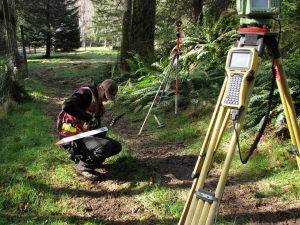
land surveyingLand Surveyors are professionals who txke precise measurements to determine the size and boundaries of a piece of real estate.  While this is a simplistic definition, boundary surveying is one of the most common types of surveying related to home and land owners. If you fall into the following categories, please click on the appropriate link for more information on that subject:

Fort Worth Land Surveying services:

    1. I need to know where my property corners or property lines are. (Boundary Survey)
    2. I have a loan closing or re-finance coming up on my home in a subdivision. (Lot Survey)
    3. I need a txp of my property with contour lines to show elevation differences for my architect or engineer. (Topo Survey)
    4. I’ve just been told I’m in a flood zone or I’ve been told I need an elevation certificate in order to obtain flood insurance or prove I don’t need it. (Flood Survey)
    5. I’m purchasing a lot/house in a recorded subdivision. (Lot Survey – See Boundary Survey if you’re not in a subdivision.)
    6. I’m purchasing a larger tract of land, acreage, that hasn’t been subdivided in the past. (Boundary Survey)

Contact Fort Worth Land Surveying services TODAY at (817) 420-7540.

Posted in boundary surveying, elevation certificate, land surveying, land surveyor | Tagged boundary survey, Fort Worth Land Surveying, land surveyor, land surveyor fort-worth tx

How a Construction Surveyor Helps Keep New Commercial Projects on Schedule From Foundation to Final Grade

Fort Worth Land Surveying Posted on June 19, 2026 by Fort WorthSurveyorJune 16, 2026
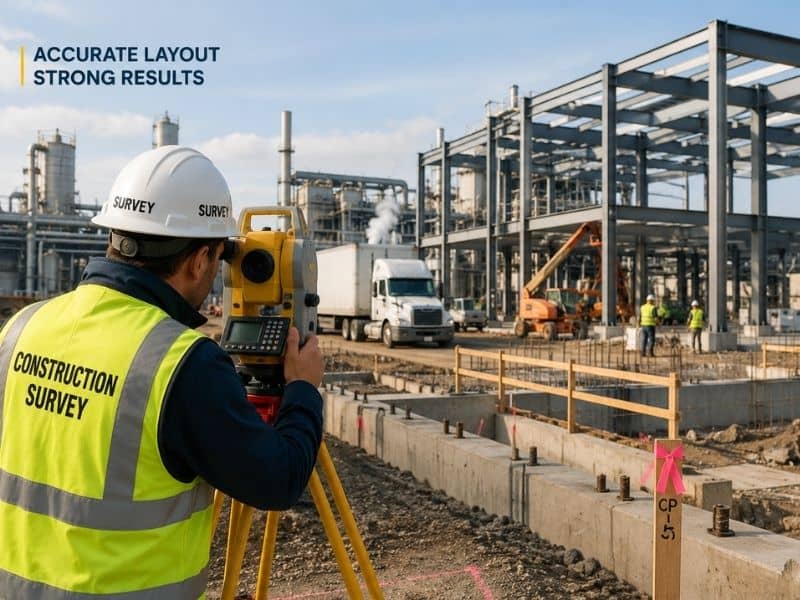
Construction surveyors using GNSS equipment to verify locations and elevations throughout a commercial building project.

Most people don’t think about construction surveyors until something goes wrong. A foundation gets poured in the wrong spot. A loading dock ends up two feet off from where the trucks are supposed to pull in. A drainage issue shows up six months after the building opens. These aren’t freak accidents. They’re what happens when accurate measurements aren’t part of the process from day one.

On commercial projects, a construction surveyor is the person making sure the numbers on the plans match what’s actually being built in the field. That job starts before the first shovel hits the ground and doesn’t end until the site is finished and handed over.

Establishing Control Points That Keep Every Trade Working From the Same Reference

Before any grading or digging begins, the surveyor sets up control points around the site. Think of these as the master reference for the entire project. Every measurement taken by every crew ties back to them.

This is more important than it sounds. A commercial job site has concrete crews, steel crews, mechanical contractors, and inspectors all working at different times, sometimes overlapping. If each trade is using a slightly different reference, small errors start adding up fast. A wall that’s off by two inches on one end can create a real conflict by the time it connects with work another crew did on the opposite side of the building.

Control points keep everyone on the same page. When something doesn’t line up, the team can trace it back and fix it before it gets buried in the next phase of work.

Verifying Foundation and Structural Locations Before Concrete Is Poured

Concrete is permanent. Once it sets, your options for fixing a mistake get a lot more expensive and time-consuming. That’s why surveyors check footing locations, column positions, and building corners before the pour happens, not after.

On a typical commercial foundation, the checks usually cover:

  • Anchor bolt and column centerline positions
  • Building corners measured against property lines and required setbacks
  • Footing elevations that affect how the floor system and drainage will sit

Finding a layout error before the pour might cost an hour of repositioning. Finding it after means saw-cutting, removing concrete, and waiting for a new pour to cure. Most project managers who’ve been through that once don’t skip the pre-pour survey the second time.

Supporting Equipment Installation With Precise Field Measurements

A commercial building has a lot going on beyond the walls and roof. Generators, fuel tanks, elevator pits, loading docks, and mechanical equipment all have to go in specific spots to work correctly and pass inspection.

If a generator pad gets poured at the wrong elevation, the electrical connections may not reach. If a loading dock frame goes in two feet off from the design, the truck approach won’t function the way the site was planned. These aren’t problems you can patch easily after the fact.

Surveyors stake out equipment pad locations, check rough-in elevations for mechanical systems, and confirm utility connection points before any of that work becomes permanent. It’s not flashy work, but it’s the kind of thing that keeps a project from carrying avoidable problems into the finish phase.

Performing Ongoing Field Checks as Construction Milestones Are Reached

A surveyor doesn’t just show up at the start and move on. They come back at different points throughout the project to check that completed work is where it’s supposed to be.

Wall locations get checked after framing. Floor elevations get verified before finish materials go down. Structural elements get confirmed while they’re still accessible, before mechanical and electrical work covers them up.

Construction accumulates small errors over time. A wall that’s slightly off at one end can be noticeably off by the time it reaches the far corner of a large building. Regular field checks catch that kind of drift before it compounds. They also give the project team solid data at each stage, so if anyone asks whether the work matches the plans, there’s a real answer backed by measurements.

Confirming Final Site Grades Before Project Closeout

The last survey task on most commercial projects is checking the finished site grades. It’s easy to treat this as a box to check before closeout. It’s actually one of the more consequential checks on the whole project.

Parking areas, drive lanes, landscape zones, and the ground around the building all need to drain in specific directions. If the finished grades don’t match what the civil engineer designed, water ends up where it shouldn’t. Pavement breaks down faster. Ponding shows up near entrances or along building walls. Some of those problems don’t appear until the first heavy rain after the owner moves in.

Final grade data is also part of the closeout documentation that projects need for occupancy approval. The surveyor’s field report shows that the site was built to the design, which protects everyone if questions come up later.

Frequently Asked Questions

What does a construction surveyor do during a commercial project?
A construction surveyor provides layout information, verifies key locations, and performs field checks to help keep work aligned with the design plans.

Why are control points important during construction?
Control points give every contractor and trade a common reference, helping maintain accuracy throughout the project.

Does a construction surveyor only work at the beginning of a project?
No. Surveyors often return at different stages to verify locations, elevations, and completed work as construction progresses.

How do construction surveyors help prevent delays?
Accurate measurements and ongoing field verification help identify issues early, reducing the need for rework and keeping schedules on track.

Why is final grade verification important?
Final grade checks confirm that the completed site meets design requirements and supports proper drainage and long-term performance.

Posted in construction, land surveyor | Tagged construction survey, land surveyor

Why Builders in Fort Worth Are Using LiDAR Mapping to Plan Around Existing Tree Lines and Preserve More Open Space

Fort Worth Land Surveying Posted on June 17, 2026 by Fort WorthSurveyorJune 16, 2026
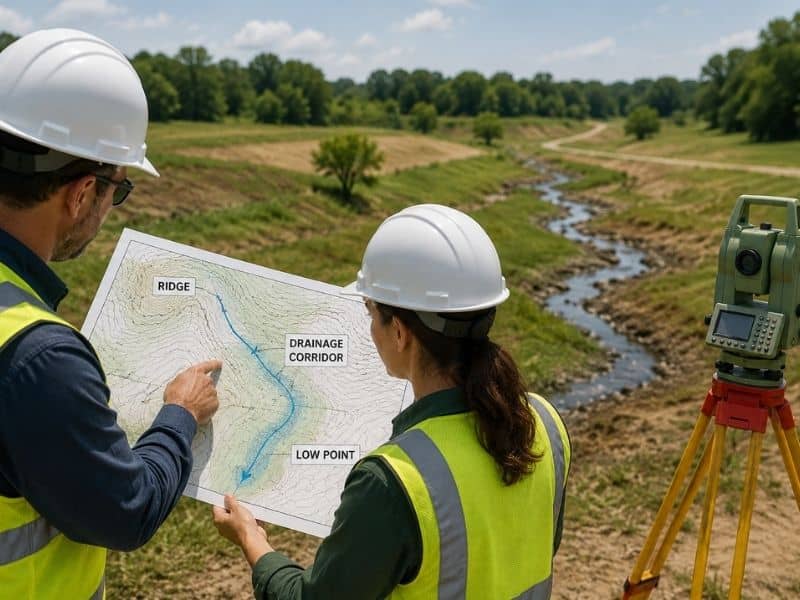
Construction and land surveying professionals coordinating residential development plans before building begins.

Most residential lots in Fort Worth don’t start as empty fields. They start as wooded parcels with decades of grown trees, uneven ground, and natural drainage patterns that took years to form. The old instinct was to clear all of it and build from scratch. That instinct is getting expensive, and buyers are noticing.

More builders here are turning to LiDAR mapping before breaking ground, not to find reasons to clear less, but because the data actually helps them build better. When you can see the full terrain in precise detail before a single stake goes in the ground, you stop guessing. And on wooded sites, guessing wrong costs real money.

LiDAR works by firing laser pulses at the ground and measuring how long they take to bounce back. The result is a dense 3D model of the land, every slope, every drainage low point, every cluster of trees. That model doesn’t replace good site judgment, but it gives the people making decisions something concrete to work with.

Using LiDAR Mapping to Define Natural Buffers Between Homes and Wooded Areas

A mature tree line along a property edge does things a fence can’t. It cuts road noise. It creates genuine visual privacy. It gives a lot of a sense of depth that newly planted shrubs take fifteen years to replicate, if they ever do.

LiDAR mapping shows builders exactly where those clusters sit before the lot layout gets drawn. That matters because a tree line that looks like it’s “over there” on a flat survey map might actually run right through where someone planned to put a driveway. Catching that early means the layout can shift around the trees rather than through them.

The builders doing this well in Fort Worth aren’t preserving trees out of sentiment. They’re keeping buffers because buyers are paying attention to them, and because removing a forty-year-old tree line to put in a strip of sod is a trade most homeowners would reject if they understood what was being swapped.

Finding the Best Locations for Yards, Patios, and Outdoor Living Spaces

Bad outdoor space placement is one of those problems that doesn’t show up until after closing. A patio poured over a natural low spot becomes a puddle collector. A backyard that slopes toward the foundation creates drainage headaches that are annoying and expensive to fix.

LiDAR elevation data gives builders a chance to avoid those problems before grading begins. The terrain model shows which areas of a lot are naturally flat, which slopes drain away from the structure cleanly, and where existing tree coverage already provides shade for outdoor living areas.

A few practical things this data helps clarify:

  • Where a patio or deck sits on stable, level ground without heavy earthwork
  • Which yard areas drain naturally without needing engineered correction
  • Where mature canopy already exists so outdoor spaces don’t bake in the Texas afternoon sun

Getting placement right the first time also reduces grading costs. Less cutting and filling means the project moves faster and the finished lot requires less ongoing maintenance.

Identifying Mature Trees Worth Protecting During Site Development

Not every tree on a wooded lot is worth saving. Some are weak, poorly positioned, or too close to where foundations need to go. But some are genuinely irreplaceable, and the problem on most Fort Worth sites is that nobody stops to figure out which is which before clearing begins.

LiDAR point cloud data shows the height and canopy spread of tree clusters across a site. Combined with a walkthrough, that information gives project teams a real basis for decisions: keep the hardwoods on the south edge, clear the scrubby undergrowth near the footprint, and leave the creek buffer alone.

Mature trees add documented value to finished homes. A full canopy reduces summer cooling loads, which matters in a North Texas summer. A lot with established trees photographs better, sells faster, and holds value differently than a cleared lot with nursery plantings. Losing a sixty-year-old post oak to save two days of planning is a bad trade, and LiDAR mapping makes it easier to avoid making it.

Planning Utility Corridors Without Unnecessary Tree Removal

Running utilities through a wooded site used to mean cutting a wide path and sorting out the damage later. The logic was simple: clearing is cheaper than precision. That logic holds up until you add in the cost of regrading, erosion control, and replacing vegetation that took generations to establish.

With a detailed terrain model, engineers can route water lines, electrical conduit, and drainage infrastructure along natural low points and between significant trees. The corridor gets narrower. The disturbance footprint shrinks. The crew isn’t fighting the terrain because the plan was designed around it.

This isn’t just an environmental preference. Smaller clearing areas mean faster site recovery, lower restoration costs, and less exposure to erosion problems during the construction window.

Supporting Neighborhood Appeal Through Smarter Land Disturbance Practices

There’s a reason some Fort Worth neighborhoods feel settled and others feel raw years after construction ends. A lot of it comes down to whether the natural features of the land survived the building process.

Communities that kept mature trees and preserved open green space consistently outperform scraped developments in resale value and buyer satisfaction. People want shade. They want some privacy. They want to feel like the place they bought into wasn’t just bulldozed and rebuilt from zero.

Builders in Fort Worth who use LiDAR mapping early in planning aren’t just being careful with the land. They’re delivering finished properties that look like they belong where they were built. That’s harder to quantify than a grading cost, but buyers feel it immediately.

Frequently Asked Questions

Can LiDAR mapping help builders preserve more trees during development?
Yes. LiDAR mapping provides detailed terrain information that helps builders design around existing tree lines and limit unnecessary clearing.

Why are natural tree buffers important for residential properties in Fort Worth?
Natural buffers improve privacy, reduce noise, provide shade during hot Texas summers, and help maintain the character of the surrounding landscape.

Does preserving open space increase construction costs?
Not necessarily. In many cases, strategic planning with LiDAR data reduces unnecessary grading and clearing expenses while protecting valuable landscape features.

Can LiDAR mapping help with utility planning on wooded sites?
Yes. Terrain models allow engineers and builders to identify practical utility routes while minimizing impacts to trees and natural areas.

When should LiDAR mapping be performed if preserving tree lines is a priority? LiDAR mapping is most effective during the early planning stage, before lot layouts, utility routes, and clearing activities begin.

Posted in land surveying | Tagged land survey

Post navigation

← Older posts
Get Quote Button
© Fort Worth Land Surveying
Fort Worth, Texas
Phone: (817) 420-7540

Web Development and SEO by:
N2Biz.co


Privacy Policy | Terms of Use

The owner of this website, USA Surveying & Engineering, LLC., provides coordination of professional land surveying and engineering services in all 50 states. The professional surveying and engineering services provided to you will be conducted by fully licensed professionals in your state.

Privacy Policy
↑